
Hair fall is something many of us notice gradually. A few extra strands on the pillow become more hair in the shower, a wider hair parting, or a receding hairline. At that point, we may start searching for PRP hair treatment, GFC treatment, or other hair regrowth options.
But which one should we choose?
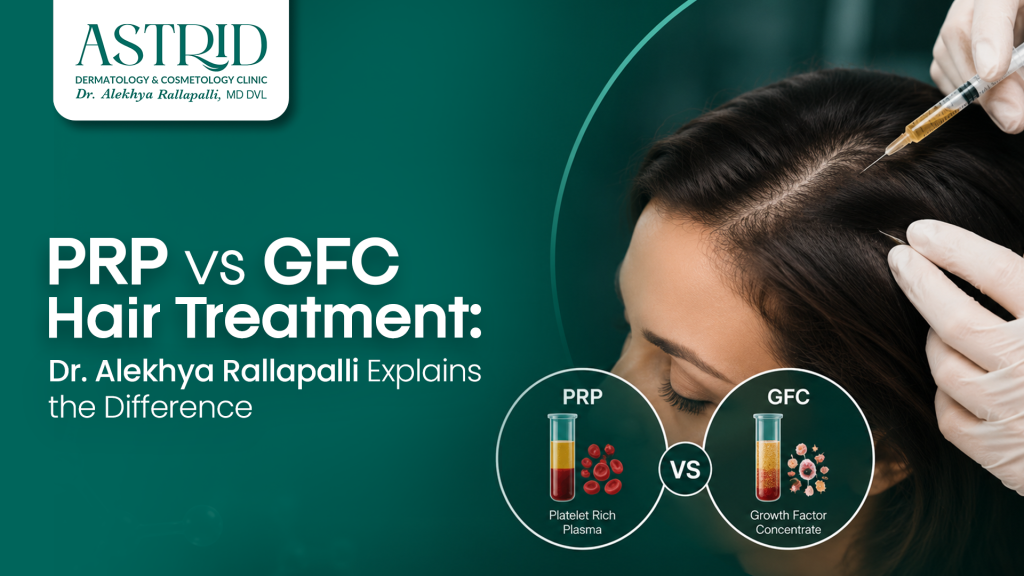
When comparing PRP vs GFC hair treatment, it is important to understand that both are blood-derived, non-surgical approaches used in hair-loss management, but they are not exactly the same. More importantly, neither treatment is automatically the best choice for every person.
Our hair loss can have different causes, including hereditary hair loss, hormonal changes, nutritional deficiencies, stress, certain medical conditions, medications, and scalp disorders. That is why identifying the cause should come before choosing a treatment.
In this guide, we explain the difference between PRP and GFC, how they work, who may benefit, what results to expect, and how Dr. Alekhya Rallapalli approaches treatment selection.
PRP Hair Treatment Explained: How It Supports Hair Growth
PRP stands for Platelet-Rich Plasma. It is a treatment that uses a concentrated portion of a person’s own blood.
During PRP treatment, a small amount of blood is collected and processed to separate its components. The platelet-rich portion is then prepared for use on targeted areas of the scalp.
Platelets contain various growth-related proteins and signalling molecules. The aim of PRP treatment for hair loss is to support the scalp environment and hair follicles through these biological signals.
PRP may be considered for certain types of hair thinning and pattern hair loss, depending on the individual’s condition. However, results can vary, and it should not be presented as a guaranteed cure for baldness.
GFC for Hair Loss: How Does This Treatment Work?
GFC stands for Growth Factor Concentrate. GFC hair treatment focuses on concentrated growth factors derived through a blood-based preparation.
The basic idea is to use growth-factor components to support the scalp and hair follicles. Like PRP, GFC is a non-surgical treatment that may be considered for selected people experiencing hair thinning or hair loss.
However, the preparation process and treatment protocol can differ between clinics. Therefore, when we compare GFC treatment for hair loss with PRP, we should look beyond marketing claims and understand exactly what procedure is being offered.
PRP or GFC? Breaking Down the Key Differences
The easiest way to understand PRP vs GFC for hair loss is to compare their basic approaches.
| Feature | PRP Hair Treatment | GFC Hair Treatment |
| Full form | Platelet-Rich Plasma | Growth Factor Concentrate |
| Basic approach | Uses platelet-rich plasma prepared from the patient’s blood | Uses a preparation focused on growth factors |
| Treatment type | Non-surgical | Non-surgical |
| Blood-derived | Yes | Yes, depending on the specific protocol |
| Main focus | Platelets and their associated biological signals | Concentrated growth-factor signalling |
| Treatment suitability | Depends on the cause and stage of hair loss | Depends on the cause and stage of hair loss |
| Number of sessions | Individualized | Individualized |
| Results | Vary from person to person | Vary from person to person |
| Downtime | Usually limited | Usually limited |
| Best choice | Determined after assessment | Determined after assessment |
The important point is that PRP or GFC which is better cannot be answered with one treatment for everyone. Your diagnosis, scalp condition, follicle health, degree of hair thinning, and treatment goals all matter.
PRP or GFC: Which Treatment Is Better for Hair Loss?
This is probably the first question most people ask.
The honest answer is: there is no universal winner.
Suppose two people visit us with hair thinning. One may have early hereditary hair loss, while another may have excessive shedding after a period of stress or nutritional deficiency. Their treatment plans may be completely different.
Before recommending PRP or GFC, we should consider:
- The type and cause of hair loss
- How long the hair loss has been present
- The degree of thinning
- Scalp health
- Hair follicle condition
- Age and overall health
- Previous treatments
- Individual treatment goals
A proper consultation helps us determine whether PRP, GFC, another treatment, or a combination approach is more appropriate.
Could PRP Be Right for Your Hair Loss?
PRP may be considered for selected patients experiencing certain forms of hair thinning or non-scarring hair loss.
People may seek PRP when they notice:
- Gradual hair thinning
- Reduced hair density
- Early pattern hair loss
- A widening hair part
- Mild to moderate thinning
- Early changes around the hairline
However, not every type of hair loss responds to the same treatment. Sudden hair loss, patchy bald spots, significant scalp inflammation, or unexplained shedding should be evaluated medically before starting a cosmetic hair procedure.
Who May Be Considered for GFC Hair Treatment?
GFC treatment may also be considered for people concerned about hair thinning and reduced density.
The important word is “considered.” We should not assume that GFC is suitable simply because it is advertised as a newer hair-growth treatment.
A dermatologist can assess the scalp and hair-loss pattern and determine whether GFC is appropriate for the individual.
This personalized approach is especially important for Indian men and women who may experience hair loss due to multiple contributing factors, including genetics, lifestyle, hormonal changes, nutritional issues, or underlying conditions.
What Happens During PRP or GFC Treatment?
Although protocols can vary, the treatment generally starts with a consultation and scalp assessment.
If a blood-derived treatment is considered appropriate, the process may involve:
- Consultation and assessment:
We evaluate the pattern and severity of hair loss. - Blood collection:
A small amount of blood is collected. - Preparation:
The blood is processed according to the specific PRP or GFC protocol. - Scalp treatment:
The prepared product is administered to selected areas of the scalp. - Follow-up:
Progress is monitored and further treatment is planned if required.
The procedure is non-surgical, but some people may experience temporary tenderness, redness, swelling, or discomfort around the treated areas.
How Many Sessions of PRP or GFC Are Needed?
- There is no fixed number of sessions that works for everyone.
- The required treatment plan can depend on the type of hair loss, its severity, the individual’s response, and the chosen protocol.
- It is also important to understand that hair growth takes time. We should not expect dramatic changes immediately after one session.
- Instead, progress is usually assessed over time. Follow-up appointments help determine whether the treatment is producing the desired response and whether additional sessions may be appropriate.
When Will You Start Seeing Hair Growth Results?
One of the biggest mistakes we can make is expecting instant hair regrowth.
Hair follicles operate through natural growth cycles, so visible changes generally take time. Results can also differ considerably between individuals.
Some people may notice changes in hair shedding or texture before they see an improvement in overall density. Others may respond differently.
For this reason, responsible hair-loss treatment should focus on realistic expectations rather than guaranteed results.
What Does PRP or GFC Feel Like During Treatment?
Both PRP and GFC involve scalp administration, so some temporary discomfort may occur.
- Mild pinching or stinging
- Scalp tenderness
- Temporary redness
- Mild swelling
- Short-term sensitivity
The level of discomfort varies from person to person. Your doctor can explain what to expect and provide appropriate aftercare instructions.
Can PRP or GFC Permanently Cure Hair Loss?
Neither PRP nor GFC should be promoted as a guaranteed permanent cure for every form of hair loss.
For example, hereditary hair loss can continue over time. Even when a person responds well to a hair regrowth treatment, the underlying cause may still require ongoing management.
This is why a complete hair loss treatment plan may sometimes involve other clinically appropriate approaches alongside regenerative treatments.
The goal should be to understand the cause, protect existing hair where possible, and choose treatment based on individual needs.
The Right Treatment Starts With Understanding Your Hair Loss
When we are comparing PRP vs GFC hair treatment, it can be tempting to choose whichever procedure sounds newer or promises faster results.
A better approach is to start with the question: “What is causing my hair loss?”
Dr. Alekhya Rallapalli can assess the individual’s hair and scalp concerns before discussing appropriate treatment options. This allows the treatment plan to be based on the person’s condition rather than a one-size-fits-all approach.
Whether PRP, GFC, another hair-loss treatment, or a combination approach is considered, understanding the diagnosis and setting realistic expectations should remain the priority.
Frequently Asked Questions
1. Is PRP better than GFC for hair loss?
Neither treatment is universally better. The appropriate option depends on the cause and stage of hair loss, scalp health, follicle condition, and individual treatment goals. A professional assessment can help determine which approach is suitable.
2. What is the main difference between PRP and GFC?
PRP uses platelet-rich plasma prepared from the patient’s blood, while GFC focuses on a preparation containing concentrated growth factors. Their preparation methods and protocols can differ, so the exact treatment should be discussed with your doctor.
3. How many PRP or GFC sessions are needed for hair growth?
There is no universal number. Treatment frequency and the total number of sessions depend on the individual’s hair-loss condition, treatment protocol, and response. Your doctor can recommend a personalized schedule.
4. Are PRP and GFC suitable for both men and women?
They may be considered for both men and women with certain hair-loss conditions. However, suitability depends on the underlying cause of hair loss rather than gender alone.
5. Can PRP or GFC completely stop hair loss?
No treatment should be presented as a guaranteed permanent solution for every type of hair loss. Identifying and managing the underlying cause is important, and some people may require ongoing treatment or a combination approach.
Ready to Choose? Start With the Cause of Your Hair Loss
PRP and GFC are both options that may be considered for selected hair-loss concerns, but choosing between them should not be based on an online comparison alone.
If you are noticing increased hair fall, thinning, reduced density, or a receding hairline, an early consultation can help identify what may be happening.
The right hair treatment is not necessarily the most popular one. It is the one that makes sense for your individual hair-loss condition and treatment goals.
With guidance from Dr. Alekhya Rallapalli, we can better understand whether PRP or GFC for hair loss is appropriate and what a realistic treatment plan may look like.
Book for an appointment today: +91 8495898989
Visit our website: https://dralekhyadermatologist.com/