
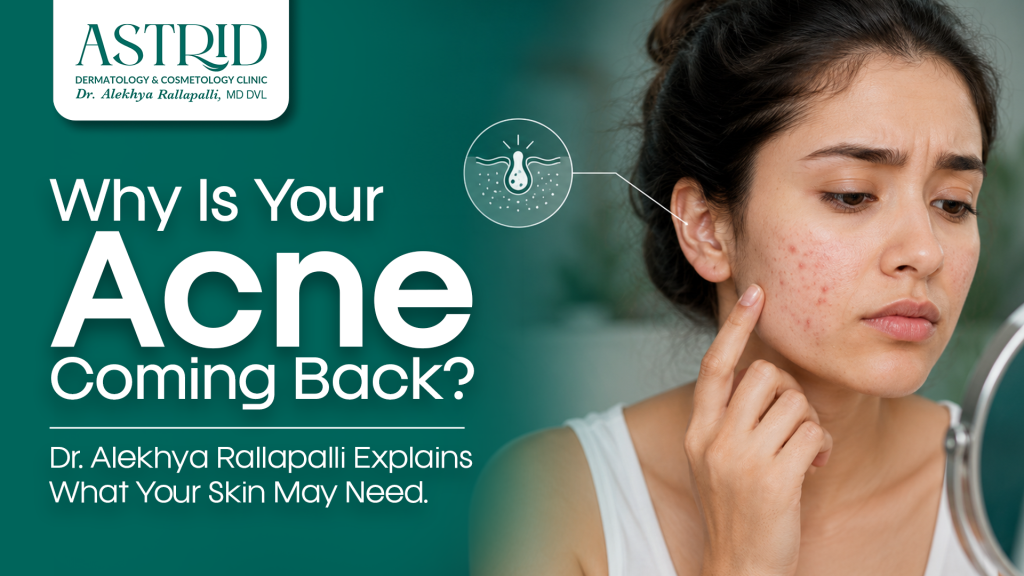
Have you ever felt relieved because your acne finally cleared—only to notice new pimples appearing again a few weeks later? If your acne keeps coming back, you are not alone. Recurring breakouts are common in both teenagers and adults, and they do not always mean that you are doing something wrong.
Acne can return because the underlying trigger has not been addressed. Hormonal changes, excess oil production, clogged pores, stress, unsuitable skincare products, and inconsistent treatment can all play a role. In some cases, the skin may improve temporarily but still need a long-term maintenance approach.
According to Dr. Alekhya Rallapalli, effective acne care is not simply about treating the pimples we can see. We also need to understand why they are returning and create a routine that helps control future breakouts.
What Does Recurring Acne Really Mean?
Recurring acne refers to breakouts that repeatedly appear after periods of improvement. You may notice pimples in the same areas, such as the forehead, cheeks, jawline, or chin, or experience occasional flare-ups despite using acne products.
A common mistake is to assume that clear skin means the acne problem has completely disappeared. Acne is influenced by processes happening beneath the skin, including oil production, blocked pores and inflammation. Therefore, stopping treatment immediately after the skin looks better may allow breakouts to return.
This is why Recurring Acne Treatment often involves both active treatment and prevention.
Why Does Acne Keep Coming Back?
There is rarely one single explanation. Let us look at some of the most common causes of recurring acne.
1. Hormonal Changes
Hormones can influence how much oil our skin produces. Teenagers commonly experience acne during puberty, while adults may develop hormonal breakouts around the menstrual cycle or during other hormonal changes.
Hormonal acne often appears around the lower face, jawline and chin, although patterns can vary.
If breakouts repeatedly follow a particular cycle, it is worth discussing the pattern with a dermatologist rather than repeatedly changing skincare products.
2. Treatment Was Stopped Too Soon
One of the most common reasons acne returns is stopping treatment as soon as the skin becomes clear.
For example, someone may use an acne medication for several weeks, see improvement and discontinue it. If the factors contributing to acne are still active, new breakouts may gradually appear.
This does not mean we should use acne medication indefinitely without medical advice. Instead, a dermatologist can decide whether a maintenance treatment is appropriate and how long it should be continued.
3. Your Skincare Routine May Be Working Against You
More skincare does not necessarily mean better skin.
Using several exfoliants, scrubs, strong acne products or heavy creams at the same time can irritate the skin. Some products may also be unsuitable for acne-prone skin.
We should be especially careful about frequently switching products because of social media recommendations or trying several “quick fixes” at once.
A simple routine with suitable products is often easier to follow consistently.
4. Stress May Trigger Flare-Ups
Stress does not cause every case of acne, but it can contribute to worsening breakouts in some people.
Busy work schedules, examinations, poor sleep and lifestyle changes can make it harder to maintain a consistent skincare routine. Stress-related changes in the body may also influence acne activity.
Instead of blaming ourselves for every breakout, we can focus on manageable habits such as adequate sleep, regular meals, exercise and a consistent skincare routine.
5. Diet May Play a Role for Some People
Diet and acne can be a confusing topic because there is no single “acne diet” that works for everyone.
Some people notice that certain foods appear to coincide with breakouts, while others do not notice a clear connection. Rather than unnecessarily eliminating many foods, we can observe patterns and discuss concerns with a healthcare professional.
A balanced diet is generally a better approach than extreme food restrictions.
6. Popping Pimples Can Make Things Worse
When acne appears, it can be tempting to squeeze or pick it.
Unfortunately, this can increase inflammation and may raise the risk of post-acne marks and scars. Repeated picking can also prolong healing.
If a pimple keeps returning in the same location, treating the underlying acne tendency is usually more useful than repeatedly squeezing the individual spot.
Recurring Acne vs Temporary Breakouts: What Is the Difference?
Not every pimple means we have chronic or persistent acne. Understanding the difference can help us decide when professional advice may be useful.
| Feature | Occasional Breakout | Recurring Acne |
| Frequency | Appears occasionally | Keeps returning |
| Pattern | Often linked to a temporary trigger | May follow a repeated pattern |
| Duration | Usually settles relatively quickly | Continues or repeatedly flares |
| Common causes | Product change, stress or lifestyle factors | Hormones, oil production, clogged pores and ongoing triggers |
| Treatment approach | Basic skincare may sometimes be enough | May require personalised dermatologist-guided treatment |
| Prevention | Focus on avoiding triggers | Often needs a maintenance strategy |
The important point is that recurring acne does not necessarily mean severe acne. Even mild but frequent breakouts can affect confidence and may benefit from professional assessment.
What Can Recurring Acne Treatment Involve?
There is no single treatment that is suitable for everyone. A dermatologist may first assess the type of acne, its severity, skin type, previous treatments and possible triggers.
Depending on the individual situation, treatment may include:
- Topical acne treatment to help control clogged pores and inflammation.
- Retinoids when appropriate to support prevention of clogged pores.
- Benzoyl peroxide in suitable cases to help manage acne-causing bacteria and inflammation.
- Treatment approaches for hormonal acne when hormonal factors appear important.
- Advice on skincare products and daily habits.
- A maintenance plan to reduce the likelihood of future flare-ups.
Prescription acne medication should be used under appropriate medical guidance. We should avoid starting, stopping or combining medications simply because someone online recommends them.
Why Maintenance Matters After Acne Clears?
Imagine treating acne like cleaning a room. Removing the visible mess is important, but if the underlying source of the mess remains, it can return.
Once active acne improves, a dermatologist may recommend a maintenance approach based on your skin’s needs. This can help manage the factors that contribute to recurring breakouts.
Maintenance does not necessarily mean using multiple products. In many cases, the goal is a practical routine that we can follow consistently without unnecessarily irritating the skin.
Skincare Habits That May Need a Rethink
Our climate, lifestyle, and skincare habits can influence how comfortable our skin feels.
Some people may experience increased sweating and oiliness. We may also use fairness products, heavy creams, hair oils, or multiple cosmetic products that do not suit acne-prone skin.
Here are a few habits worth reviewing:
- Avoid excessive scrubbing: Scrubbing harder does not remove acne and can irritate the skin.
- Do not copy someone else’s routine: A product that works for one person’s skin may not suit another person’s acne.
- Be careful with DIY remedies: Lemon juice, toothpaste and harsh household ingredients can irritate the skin.
- Check hair and skincare products: Products that come into contact with the forehead, temples or cheeks may contribute to breakouts in some people.
- Stay consistent: Constantly changing products makes it difficult to understand what is helping or irritating your skin.
When Should We See a Dermatologist?
Professional evaluation becomes particularly useful when acne:
- Keeps returning despite a consistent routine.
- Is painful, deep or inflamed.
- Leaves dark marks or scars.
- Is affecting confidence or daily life.
- Appears suddenly in adulthood.
- Seems strongly connected with hormonal changes.
- Does not improve despite appropriate over-the-counter care.
If you have been trying one product after another without lasting improvement, the answer may not be another product. We may need to identify the underlying reason for the repeated breakouts.
Recurring Acne Treatment in Banjara Hills: A Personalised Approach
If you are looking for acne treatment in Banjara Hills, the first step should be understanding your individual skin concerns rather than choosing treatment based only on advertisements or online trends.
Dr. Alekhya Rallapalli focuses on evaluating the patient’s skin, acne pattern, possible triggers and treatment history before recommending an appropriate approach.
For teenagers, the treatment plan may differ from that of an adult experiencing hormonal or persistent acne. Similarly, someone with occasional pimples may need a very different strategy from someone with inflammatory acne and acne scars.
The goal of dermatologist-guided care is not simply to make today’s breakout disappear. It is to help us manage acne more effectively over time while reducing unnecessary irritation and the risk of scarring.
Frequently Asked Questions
1. Why does my acne keep coming back after treatment?
Acne may return when underlying factors such as hormonal changes, excess oil, clogged pores or inflammation are still active. Stopping treatment too early or using unsuitable skincare products may also contribute.
2. What is the best treatment for recurring acne?
There is no single best treatment for everyone. A dermatologist may recommend topical treatments, retinoids, benzoyl peroxide, hormonal approaches or other options depending on the type and severity of acne.
3. Is recurring acne always hormonal?
No. Hormones can contribute to recurring acne, but other factors such as oil production, clogged pores, skincare products, stress and genetics can also play a role.
4. Can we prevent acne from coming back?
We may be able to reduce recurring breakouts through appropriate skincare, identifying personal triggers and following a dermatologist-recommended maintenance plan. Consistency is often important.
5. When should I see a dermatologist for recurring acne?
Consider seeing a dermatologist if acne repeatedly returns, becomes painful or severe, leaves marks or scars, affects your confidence, or does not improve with a consistent skincare routine. A dermatologist can determine whether you need professional recurrent acne treatment.
When Acne Keeps Returning, Your Skin May Need a New Approach
When acne keeps coming back, repeatedly changing creams, face washes and home remedies may not solve the real problem.
Recurring acne can have different triggers, including hormones, excess oil, clogged pores, inflammation, stress, unsuitable products and inconsistent treatment. That is why effective Recurring Acne Treatment should be personalised.
With the right assessment, realistic expectations and a consistent maintenance plan, we can take a more structured approach to managing acne.
If your acne that keeps returning is becoming frustrating, consider speaking with a qualified dermatologist in Banjara Hills. Understanding why your acne returns can be the first step toward managing it more confidently.
Book for an appointment today: +91 8495898989
Visit our website: https://dralekhyadermatologist.com/