
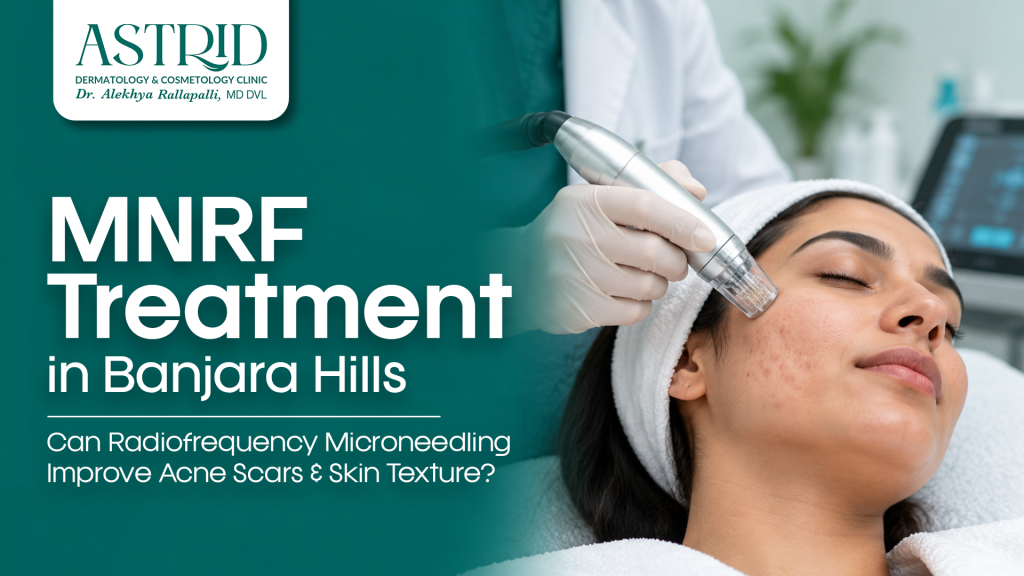
Acne may eventually settle, but the marks it leaves behind can stay much longer. For many people, acne scars, enlarged pores, and uneven skin texture can affect how confident they feel about their appearance. This is why treatments that support skin renewal and collagen production have become increasingly popular.
MNRF treatment is one option we may consider for improving certain types of acne scars and uneven skin texture. MNRF, or microneedling radiofrequency, combines controlled microneedling with radiofrequency energy to stimulate the skin at different depths.
But does it really work for acne scars? Is it suitable for Indian skin? And is it better than laser treatment?
Let us understand what MNRF can realistically do, who may benefit from it, and what we should expect before choosing treatment.
Understanding Microneedling Radiofrequency Treatment
MNRF stands for Microneedling Radiofrequency. It combines two approaches: tiny needles create controlled micro-injuries in the skin, while radiofrequency energy delivers heat into selected deeper layers.
This controlled stimulation encourages the skin’s natural healing process and collagen remodeling. Over time, this may help improve the appearance of depressed acne scars, uneven texture, and some other signs of skin ageing.
Unlike simple microneedling, MNRF adds radiofrequency energy to the treatment. The depth and energy can be adjusted according to the patient’s skin condition, scar type, and treatment goals.
For this reason, MNRF skin treatment should not be treated as a one-size-fits-all procedure.
Understanding MNRF Treatment for Acne Scars
Yes, MNRF may improve the appearance of certain acne scars, particularly atrophic or depressed scars.
Acne scars are not all the same. Rolling scars, boxcar scars, and ice-pick scars have different structures and may respond differently to treatment.
MNRF works by creating controlled stimulation beneath the skin. As collagen remodeling takes place, the treated area may gradually look smoother and more even.
However, we should keep expectations realistic. MNRF does not guarantee complete acne scar removal. Deep or complex scars may require a combination of treatments selected after a dermatologist examines the skin.
This distinction is important because treating a scar effectively starts with identifying what type of scar we are dealing with.
Improving Uneven Skin Texture With MNRF
During treatment, very fine needles enter the skin to a selected depth. Radiofrequency energy is then delivered through the microneedle tips. This creates controlled thermal stimulation in the targeted skin layers.
The healing process can encourage collagen remodeling. As new collagen develops over time, we may see gradual improvement in:
- Depressed acne scars
- Uneven skin texture
- Rough-looking skin
- Enlarged pores
- Mild skin laxity
- Overall skin smoothness
The results are gradual rather than instant. Our skin needs time to heal and remodel collagen, so patience is an important part of the process.
MNRF for Acne Scars vs Other Skin Treatments
People often compare MNRF with laser resurfacing, traditional microneedling, and chemical peels. The right choice depends on the patient’s skin and the problem being treated.
| Treatment | Main Approach | Potential Use for Acne Scars | Downtime |
| MNRF | Microneedling + RF energy | Atrophic scars and texture | Usually limited to moderate |
| Traditional Microneedling | Controlled needle stimulation | Mild scars and texture | Generally limited |
| Fractional Laser | Laser-based skin resurfacing | Acne scars and texture | Can vary from limited to several days |
| Chemical Peel | Controlled chemical exfoliation | More useful for selected marks and superficial concerns | Depends on peel strength |
There is no single treatment that is best for everyone. MNRF vs laser for acne scars should be decided after considering scar depth, skin type, pigmentation risk, downtime preferences, and previous treatments.
For Indian skin, these factors are particularly important because some people are more prone to post-inflammatory pigmentation following skin procedures.
Why MNRF May Be Considered for Indian Skin?
Indian skin can respond differently to cosmetic procedures, particularly when pigmentation is a concern. Therefore, treatment settings need to be selected carefully.
One reason radiofrequency microneedling for acne scars is considered by some dermatologists is that the energy can be delivered at controlled depths rather than relying entirely on aggressive surface resurfacing.
However, we should not assume that MNRF is automatically suitable or risk-free for every Indian skin type. A professional assessment remains essential.
The dermatologist may consider skin tone, sensitivity, active acne, pigmentation history, scar type, and previous treatments before recommending a procedure.
What Happens During MNRF Treatment?
A typical microneedling radiofrequency treatment may involve several steps:
- We assess the skin and identify the type and severity of acne scars.
- The treatment area is cleansed.
- A topical numbing cream may be applied when appropriate.
- The MNRF device is carefully applied to the targeted areas.
- Microneedles enter the skin at selected depths.
- Radiofrequency energy is delivered.
- The skin is gently cared for after treatment.
- We provide specific aftercare and sun-protection instructions.
The exact procedure and settings vary according to the device, treatment area, and individual skin condition.
MNRF Treatment Recovery: What Should We Expect?
After MNRF treatment, temporary redness, warmth, swelling, or sensitivity may occur. These effects usually settle as the skin recovers, although recovery varies between individuals.
We should follow the dermatologist’s aftercare instructions carefully. This may include:
- Using recommended gentle skincare
- Applying sunscreen regularly
- Avoiding unnecessary touching of treated skin
- Temporarily avoiding irritating skincare products when advised
- Avoiding excessive sun exposure
- Following prescribed post-treatment products
Good aftercare is not simply about comfort. It can also help support healthy recovery.
How Many MNRF Sessions Are Needed?
There is no fixed number of sessions that works for everyone.
Someone with mild texture concerns may have a different treatment plan from someone with deeper acne scars. The dermatologist may recommend multiple sessions, with sufficient time between treatments for the skin to recover and remodel collagen.
We should also remember that MNRF treatment results develop gradually. Evaluating the skin too soon may not show the full effect of collagen remodeling.
Who May Be a Good Candidate for MNRF?
MNRF may be considered for people who have:
- Atrophic acne scars
- Uneven skin texture
- Enlarged pores
- Mild skin laxity
- Post-acne texture concerns
- Realistic expectations about improvement
For teenagers and younger patients, treatment should be considered more carefully. Active acne, skin maturity, medical history, and the type of scarring all matter.
Someone with active inflammatory acne may need acne treatment first before focusing on residual scars.
When May MNRF Not Be the First Choice?
MNRF is not necessarily appropriate for every skin concern.
A dermatologist may recommend delaying or reconsidering treatment if there is active infection, significant inflammation, open wounds, uncontrolled acne, or another condition that needs attention first.
Deep ice-pick scars or complex scar patterns may also require a different procedure or a combination approach.
This is why searching for the best MNRF treatment should not simply mean choosing the clinic offering the lowest price. Proper diagnosis, treatment planning, device selection, and medical supervision matter.
What Results Can We Realistically Expect?
MNRF can support gradual improvement, but we should think in terms of scar reduction and skin improvement, not perfect or completely scar-free skin.
Results may depend on:
- Scar type
- Scar depth
- Skin type
- Age
- Healing response
- Number of treatments
- Aftercare
- Whether other procedures are combined with MNRF
Some patients may notice smoother-looking skin after treatment, while others may require a longer treatment plan.
Before-and-after photographs can be useful, but we should remember that lighting, camera angle, skin preparation, and individual healing can affect how results appear.
Is MNRF Worth Considering for Acne Scars?
For the right patient, MNRF can be a useful acne scar treatment in Banjara Hills, especially when the main concern involves depressed scars and uneven texture.
Its major advantage is the ability to combine microneedling with controlled radiofrequency energy while allowing treatment parameters to be adjusted.
But the most important step comes before the procedure: proper skin assessment.
If we have active acne, pigmentation, deep scars, or mixed scar types, treating everything with one procedure may not produce the best outcome. A dermatologist can determine whether MNRF alone or a combination approach makes more sense.
Frequently Asked Questions
1. Is MNRF effective for acne scars?
MNRF can improve the appearance of certain atrophic or depressed acne scars. The degree of improvement depends on scar type, depth, skin condition, and the treatment plan. Complete scar removal should not be promised.
2. Can MNRF improve skin texture?
Yes. MNRF may support collagen remodeling and improve uneven or rough skin texture. It may also help reduce the appearance of enlarged pores in selected patients.
3. How many MNRF sessions are needed for acne scars?
There is no standard number for everyone. A dermatologist may recommend multiple sessions depending on the severity and type of scarring and how the skin responds to treatment.
4. Is MNRF better than laser for acne scars?
Neither is universally better. MNRF and fractional laser treatments work differently, and the appropriate option depends on scar type, skin type, pigmentation concerns, desired downtime, and previous treatments.
5. Is MNRF suitable for Indian skin?
MNRF can be considered for Indian skin, but treatment parameters must be carefully selected. A dermatologist should assess skin type, pigmentation tendency, active acne, and scarring before treatment.
Choosing the Right Treatment for Acne Scar Improvement
MNRF treatment in Banjara Hills can be a valuable option for people looking to improve certain acne scars, uneven texture, and other skin concerns. By combining microneedling with radiofrequency energy, the treatment aims to stimulate controlled healing and collagen remodeling.
Still, the best results begin with the right diagnosis. Acne scars differ from person to person, and one treatment cannot be expected to solve every type of scarring.
If acne scars or uneven texture are affecting your confidence, we recommend consulting a qualified dermatologist or aesthetic doctor. A personalized assessment can help us understand the condition of your skin and determine whether MNRF, another procedure, or a combination treatment is the most suitable approach.
Book an appointment today: +91 8495898989
Visit our website: https://dralekhyadermatologist.com/